Imagine: you want to expand your advisory services. But how do you ensure these remain more than just good intentions? Many accounting firms think reporting software or a dashboard tool is the solution. They select a new tool, launch a pilot, and hope the rest will follow automatically.
But in practice, it turns out that advisory work won't get off the ground if it doesn't logically fit into how your organization operates. After all, it's more about people than tools.
Good intentions and tools aren't enough
In practice, it appears that the people in the workplace simply don't have the time or space to provide their clients with sound advice. They want to, but don't know when to fit it in. Especially when there is no room in the schedule to set up a clear plan.
Moreover, the real bottleneck isn't technology, but how you organize advisory work. If the new advisory software doesn't fit logically into daily operations, it quickly ends up gathering dust. The result? The tool is left unused. And with it, the advisory work.
How to make advisory work feasible
To truly make advisory work part of your service offering, it shouldn't be an add-on. How do you do that? According to Thijs Olthof, owner of Liquid, the key is to incorporate advisory work into your standard services, just like annual accounts and administration. This way, you serve different types of clients in a way that suits them. Without immediately having to resort to custom work. This also means you can plan your capacity better.
For example, start with:
• Package S: for clients who review the numbers every quarter
• Package M: for clients with monthly analysis and budget rounds
• Package L: for clients who need CFO-as-a-service
This way, both you and your client know exactly what to expect. And advisory work doesn't become a burden, but a logical part of your service.
Software as an accelerator
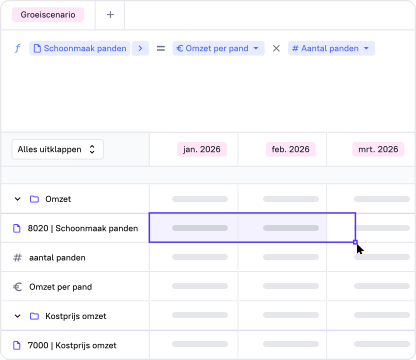
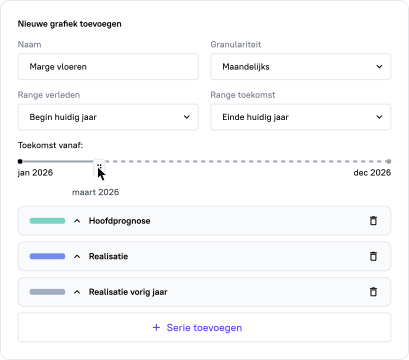
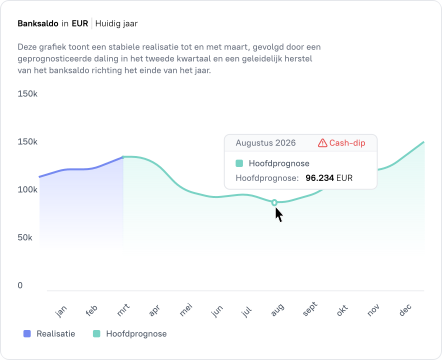
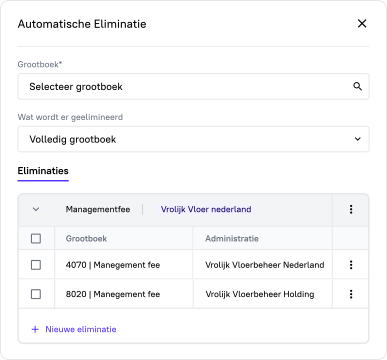
Only once you have structured your advisory work does software help to accelerate it. Tools like Liquid help you handle recurring advisory requests quickly and systematically. Think of (cash flow) forecasts or consolidation reports.
What used to take you eight hours in Excel now takes an hour and a half. And if you want to continue later, you know exactly where you left off. Software is therefore not a solution in itself, but an accelerator—provided you have the basics in order.
Advisory is about sparring, not broadcasting
Advice isn't a report you simply toss over the fence. It's about sparring, thinking along, and making choices together. That only works if you structurally set aside time for the conversation. Giving advice is therefore different from emailing a report: you want to discover together what is going on and what is possible.
First a plan, then a tool
Software only helps if you first have your revenue model clearly defined. Start with the problem you want to solve, redesign your work process, take a critical look at your revenue model, and only then choose the tools that fit.
This ensures your brand-new tool doesn't end up gathering dust and that advisory work becomes a permanent part of your service offering. And all that without draining your team's energy.