Business owners expect more relevant insights from their accountants. For the industry, this is a blessing in disguise: extensive automation of annual reporting and tax returns is forcing the accounting profession to reinvent itself. Time is of the essence, but how do you as a firm finally make the transition?
“As a firm, we want to do more with advisory services.” For many in the accounting world, this is a familiar refrain. Yet, actually making that leap proves difficult for many firms. However, the demand for advice is growing rapidly among business owners. “The volume of financial data at an average SME doubles every fifteen months,” says Thijs Olthof, CEO of Liquid. “For example, if a business owner wants to create a forecast, they often start in Excel. You make a quick start in the beginning, but the spreadsheet soon becomes complex, hard to maintain, and difficult to link to data from the accounting system, for instance. You often see business owners calling in their accountant when things get critical. But even they can’t just clear four hours at the drop of a hat to provide the necessary insights.”
Artificial Intelligence
The necessity to provide clients with more advisory support will gain momentum due to Artificial Intelligence (AI). Olthof: “It is inevitable that primary work, such as tax returns, bookkeeping, and annual accounts, will become increasingly automated. It may seem unthinkable, but in the coming years, we will move from a labor shortage to a labor surplus. At the same time, the demand for relationship managers, accountants, and controllers for complex advisory work will actually grow. As a firm, you therefore need to look at how you can relieve those people using smart software solutions and offer clients what they are asking for. The human element will become even more important.”
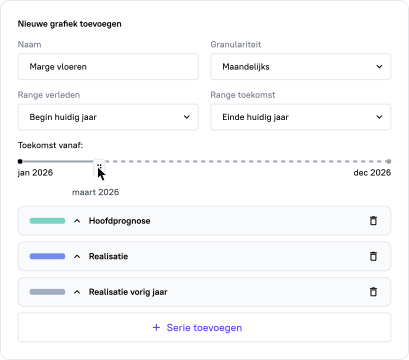
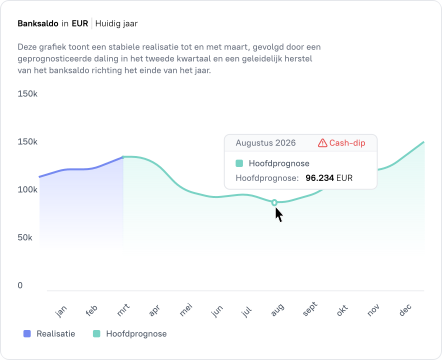
AI is now also being deployed within Liquid’s advisory software. This helps the accountant report better and provides tools to interpret information, delivering valuable input for advisory meetings. Olthof: “AI is a tool that you have to learn to use. At Liquid, we are committed to AI so that you can advise your client faster and better. Think of it as a smart colleague who is always available. It allows you to create forecasts and extrapolate insights in Liquid in an instant. It also means that colleagues who previously had little experience with advisory work can now develop professionally much faster. This makes you more relevant as a firm,” Olthof explains. “And clients are willing to pay more for that relevance.”
Translating to the future
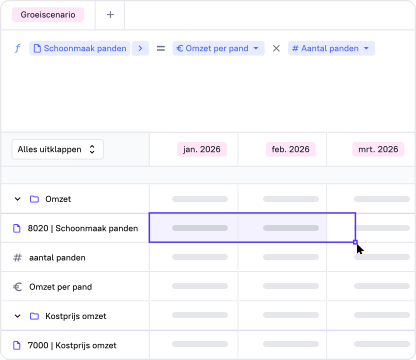
Good advisory work is often overlooked, believes Henk Aardoom, partner at Full Finance: “Many accounting firms use software packages that look backward. Making the translation to the future has been difficult for years. Liquid was developed with a clear focus on the challenges faced by business owners. It helps them do their accounting in the future, as it were.” The software works seamlessly with accounting software and payroll packages, helping to analyze the performance of business owners and, above all, look ahead. With better tools to advise clients, not only is the role of the accountant changing, but firms must also look at their revenue models. Olthof: “The continued automation of primary work, such as annual accounts and tax returns, is still in full swing. This leads to inevitable downward price pressure and forces firms to find new revenue models.”
Creating buy-in
Due to changing roles and revenue models, accounting firms must explore how new software and processes fit within the organization. According to Aardoom, young people can play an important role in creating buy-in. “Younger generations pick up new developments enthusiastically. We saw that with risk-based compilation, for example. It isn't motivating if you learn to work in a modern way during your studies, but can’t apply that at the firm. It is therefore not a good idea to hold back changes for the sake of the older generation. You have to start with the young people and motivate them to bring everyone in the organization along. They are up to date with new techniques and can take other employees under their wing. This keeps the work interesting, increases the added value for the client, and prevents people from eventually leaving.”
The human side
“Software is only twenty percent of the story; the human side of implementation is the other eighty percent,” says Olthof. That is why Liquid and Full Finance collaborate regularly. Full Finance supports administration and accounting firms with advice, guidance, and training in the fields of accountancy, taxation, mergers & acquisitions, and ICT. “For example, we help with the deployment, implementation, and adoption of software that allows firms to optimize processes. By teaming up with Liquid, we bring that human element into the process,” says Aardoom. “They help accounting firms to develop a vision and create buy-in. And that is important. If, as a firm, you don't have an advisory strategy—commercially as well—you will miss the boat in the coming years. Now is the moment to set your sights on the future,” concludes Olthof.
Text: Axel Kolthof