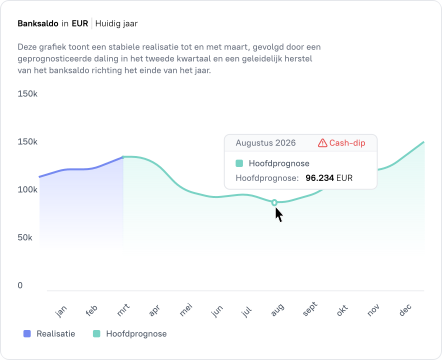
What is profitability and how do you calculate it?
Profitability is a financial metric that demonstrates a company's profit-generating capacity. It provides insight into how effectively a business deploys its capital to generate profit. This article discusses the meaning of profitability, the different types, and how to calculate this key financial indicator.
The meaning of profitability
Profitability is a core indicator of a company's financial health. It measures a business's capacity to generate profit from its available resources. High profitability indicates an efficient use of capital, while low profitability can signal problems within the operations.
Why is profitability important?
Profitability plays a crucial role in assessing a company's performance. It helps investors and business owners determine how well a company utilizes its resources to make a profit, which is essential for making decisions regarding investments and financing.
Additionally, financial institutions use profitability ratios to assess the creditworthiness of companies. Strong profitability can facilitate access to financing and result in better lending terms.
Types of profitability
There are several types of profitability, each with its own focus:
Return on Equity (ROE): Measures how effectively shareholders' equity is used to generate profit.
Return on Total Assets (ROA): Indicates how well a company deploys its total assets to make a profit.
Return on Sales (ROS): Looks at how efficiently a company converts revenue into profit.
How do you calculate profitability?
Calculating profitability requires a good understanding of a company's financial data. Below is a brief explanation of the most common profitability ratios.
Return on Equity (ROE)
ROE is calculated by dividing net profit after tax by average shareholders' equity. The formula:
ROE = (Net Profit / Average Equity) x 100%
Return on Total Assets (ROA)
ROA measures how efficiently a company uses its total assets to generate profit. The formula:
ROA = (Earnings Before Interest and Taxes (EBIT) / Average Total Assets) x 100%
Return on Sales (ROS)
ROS is calculated by dividing net profit by total revenue. The formula:
ROS = (Net Profit / Revenue) x 100%
The influence of profitability on business decisions
Profitability has a direct influence on a company's strategic decisions. Companies with high profitability can invest more in growth and enter new markets, while companies with low profitability are often forced into cost-cutting and restructuring.
Additionally, an analysis of profitability ratios provides insight into weaknesses within operations, allowing targeted actions to be taken to improve profitability.
The role of profitability in investment decisions
For investors, profitability is a key factor in assessing the potential return on their investment. Companies with stable and high profitability are often attractive to investors, whereas companies with low profitability may signal risks and limited growth opportunities.
Therefore, it is important for investors to assess not just current profitability, but also the trend over multiple years. A stable or rising profitability can inspire confidence, while declining profitability can raise questions about a company's future.
The relationship between profitability and liquidity
While profitability is important for assessing profit generation, it is also essential to consider liquidity. Liquidity refers to the extent to which a company is able to meet its short-term obligations. High profitability is valuable, but without sufficient liquidity, a company can still face financial trouble.
That is why it is important to analyze profitability and liquidity together. A healthy balance between the two is crucial for a company's financial stability and growth.
The impact of profitability on share price
Profitability often has a direct impact on the share price. Companies with strong profitability often attract investors, which can lead to an increase in share price. Conversely, a drop in profitability can cause a negative market reaction and a decline in share price.
Liquid as a partner for improving profitability
Monitoring profitability ratios is essential for strategic decisions. Liquid offers a platform that helps companies analyze their profitability, alongside other key financial indicators such as liquidity and cash flow. Whether you are a business owner, accountant, or CFO, Liquid provides the tools you need to make your company profitable and help it grow.
Conclusion
Profitability is a fundamental metric for a company's financial performance. It offers valuable insights into how effectively a business deploys its resources to generate profit. However, it is only one aspect of a company's financial health and must be analyzed in combination with other ratios to get a complete picture of a company's performance.